

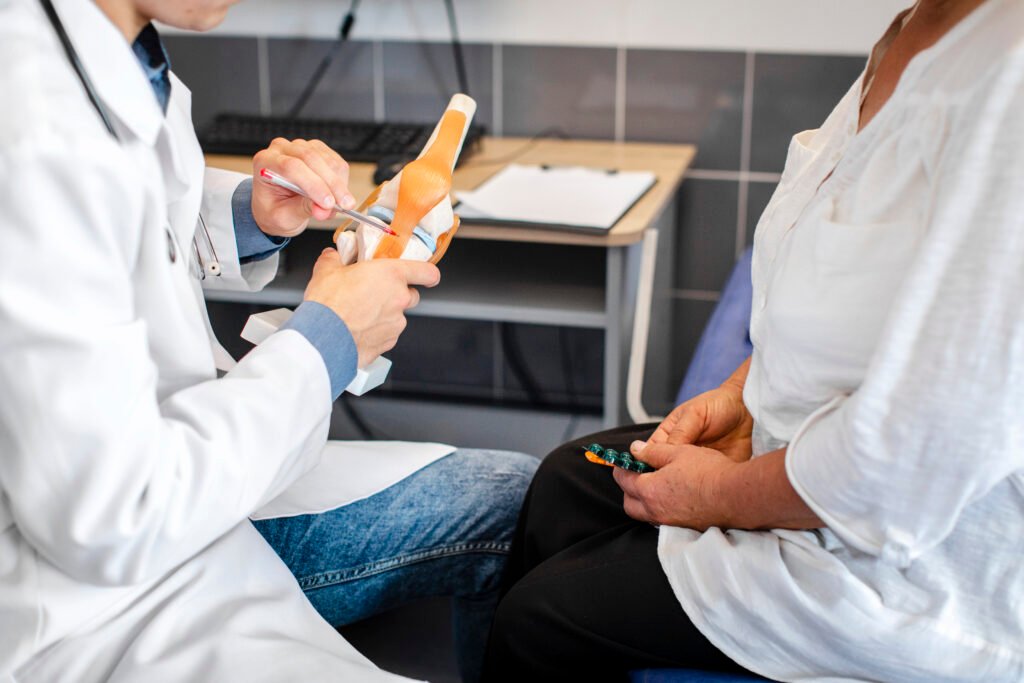
Knee pain doesn't always mean immediate surgery, but it does call for an informed evaluation. In this article, Dr. Ever García Quiñónez explains what a knee replacement is, when it's recommended, what risks are involved, and what to consider before making a decision.
What's in This Article
If knee pain is already part of your daily life — going up stairs, standing up from a chair, walking distances that used to take no effort at all — it's natural to wonder whether there's a lasting solution. For many patients, the answer is a knee replacement, also known as total knee arthroplasty.
Below, you'll find a clear explanation of what this procedure involves, when it's typically recommended, and what factors a specialist considers before suggesting it.
What Is a Knee Replacement?
A knee replacement is an implant designed to replace joint surfaces that have worn down, usually due to arthritis (osteoarthritis), a previous injury, or progressive cartilage wear. The goal is to restore joint movement and reduce the pain caused by bone-on-bone friction, in cases where other treatment options no longer provide enough relief.
When Is a Knee Replacement Recommended?
Not every case of knee pain requires surgery. The decision is made after an individual clinical evaluation, taking into account the degree of joint wear, the impact of pain on daily life, and how the patient has responded to prior conservative treatment. Some signs that often prompt a specialized evaluation include:
- Persistent knee pain that limits everyday activities such as walking, climbing stairs, or standing up from a chair
- Recurring stiffness or joint swelling
- Progressive knee deformity (bowed or knock-kneed alignment)
- Pain that doesn't improve with medication, physical therapy, or injections
- Advanced arthritis confirmed by imaging
The only way to determine whether a knee replacement is the right option is through a personalized clinical evaluation that considers the diagnosis and each patient's individual condition.
Implant Materials and Lifespan
Today's knee replacement implants are made with highly durable materials designed to withstand daily joint use. With appropriate activity modification, a knee replacement can last for many years — the exact timeframe varies by patient and is explained in detail during consultation, depending on the type of implant used.
Risks and Considerations
As with any surgical procedure, knee arthroplasty carries risk factors that Dr. García discusses with full transparency during the initial evaluation.
Rate of complications:
- Major complications: joint infections (fewer than 2% of cases) and systemic or cardiac events, which occur even less frequently.
- Procedure-related risks: blood clots (thrombosis), localized nerve injury, or gradual loosening of the implant over the years.
A patient's overall health is a determining factor, which is why a thorough, personalized medical evaluation is carried out before scheduling surgery.
What to Expect From the Process, in General Terms
Every treatment plan is built individually, but in general terms the process includes three stages:
- Initial evaluation: clinical review, imaging studies, and assessment of the degree of joint wear.
- Surgical procedure: performed under anesthesia, with the medical team managing pain during and after surgery.
- Follow-up care: ongoing support from Dr. García based on each patient's individual progress, including guidance on physical activity and rehabilitation when applicable.
This general order is adapted based on the diagnosis and each patient's specific needs.
Minimally Invasive Surgery: An Option When Clinically Appropriate
When a patient's condition allows for it, joint replacement can be performed using a minimally invasive technique, which uses smaller incisions and a more careful approach to surrounding tissue. Not every patient is a candidate for this technique — the decision depends on the degree of wear, individual anatomy, and other factors evaluated during consultation.
Life After a Knee Replacement
Once you've completed the recovery process Dr. García defines for your specific case, most patients are able to return to low-impact activities such as walking, swimming, cycling, golf, ballroom dancing, and light hiking. Each activity is reintroduced gradually and under medical guidance, based on each patient's individual condition.
Some general recommendations for the long-term care of your implant include letting any doctor who treats you know that you have a joint implant, and taking precautions to prevent falls. Dr. García provides specific guidance on this during your follow-up care.
You can read real patient experiences on the Knee and Hip Replacement in Ciudad Juárez.
Why Choose a Certified Specialist?
Joint replacement surgery is a highly precise procedure. Choosing a surgeon with certified training, ongoing education, and specific experience in arthroplasty makes a real difference in the process. You can learn more about this procedure on our Knee and Hip Replacement in Ciudad Juárez.
Dr. Ever García Quiñónez
- Member of the Ciudad Juárez College of Orthopedics
- Member of IOTA — International Orthopaedic Trauma Association
- Member of AO — Association for the Study of Osteosynthesis
- Member of FEMECOT — Mexican Federation of Orthopedic and Trauma Surgery Colleges
- Postgraduate Diploma in Periprosthetic Infection and Joint Replacement
Personalized care in Spanish and English.
Frequently Asked Questions About Knee Replacement
Recovery time depends on each patient, the type of procedure, and their prior condition. During your consultation, Dr. García evaluates your specific case and explains the recovery process that applies to your situation.
The procedure is performed under anesthesia, with pain management supervised by the medical team. The level of discomfort and how it's managed are explained individually during consultation, based on each patient's treatment plan.
Delaying evaluation doesn't resolve the underlying problem. In some cases, joint wear progresses and conservative treatment options become less effective over time. That's why a timely evaluation helps you make an informed decision, with or without surgery.
No. Its suitability depends on an individual evaluation. The specialist determines the most appropriate approach on a case-by-case basis.
The rate of serious complications is low: joint infections occur in fewer than 2% of patients. Dr. García reviews your complete medical history during consultation to assess your individual risk.
If you've already received a diagnosis or a surgery recommendation elsewhere, a second opinion gives you additional information to make an informed decision, with no pressure or obligation.
A Clinical Evaluation Determines the Right Treatment for Your Case
During your consultation, your test results are reviewed and a treatment plan is defined based on your specific situation.
Hospital Star Médica · Av. Paseo de la Victoria 4370, Suite 409, Col. Partido Iglesias, 32618 Ciudad Juárez, Chihuahua, Mexico
Tel. +52 (656) 424 4331 · WhatsApp +52 (656) 424 4331
Monday to Saturday, 7:00 AM – 10:00 PM · By appointment only
Dr. Ever García Quiñónez
Orthopedic Surgeon and Traumatologist · Ciudad Juárez, Chihuahua
Medical License 12484238 · Specialty License 15604514
Board-certified by the Mexican Board of Orthopedics and Traumatology · Member of IOTA, AO, FEMECOT, and the Ciudad Juárez College of Orthopedics
Last updated: September 2026.